Digitizing the Weekly Ad: Your Complete Guide to Promo Parity
Your weekly ad just dropped. It’s live in-store, it’s in the Sunday paper, and your merchandising team is already planning next week’s offers. But here’s the question that keeps you up at night: Is that same promotion actually showing up online where your customers are searching for it?
If you’re a marketing director at a regional retailer managing 50, 100, or even 500+ locations, you already know the answer. Your weekly circular exists in one world, but your digital channels exist in another. And the gap between those two worlds? That’s costing you traffic, revenue, and customers who simply can’t find the deals you’re promoting.
But here’s the good news: You’re not alone in facing this challenge, and there’s a clear, systematic way to fix it. This guide will walk you through exactly how to digitize your weekly ad, close the gap between print and digital, and achieve what we call Promo Parity.
Understanding Promo Parity
Promo Parity is the consistent and accurate representation of your promotional offers across all customer touchpoints, from your physical weekly circular to your website, product detail pages, Google Shopping ads, and even AI-powered search engines.
When promo parity exists, a customer sees the same offer whether they’re reading your printed circular, searching “weekly ad near me” on Google, browsing category pages on your website, or asking ChatGPT about deals in your area.
Why does this matter? Because shoppers start their journey online even when they plan to buy in-store. Google reports that 76% of people who search for something nearby visit a store within 24 hours. If your digital presence doesn’t reflect your in-store promotions, those high-intent shoppers never make it through your doors.
Promo parity isn’t just about consistency. It’s about revenue protection. Every disconnected promotion is a missed conversion and a competitive advantage you’re handing to retailers who have their digital act together.
Why Promo Parity Drives Dollars, Not Just Clicks
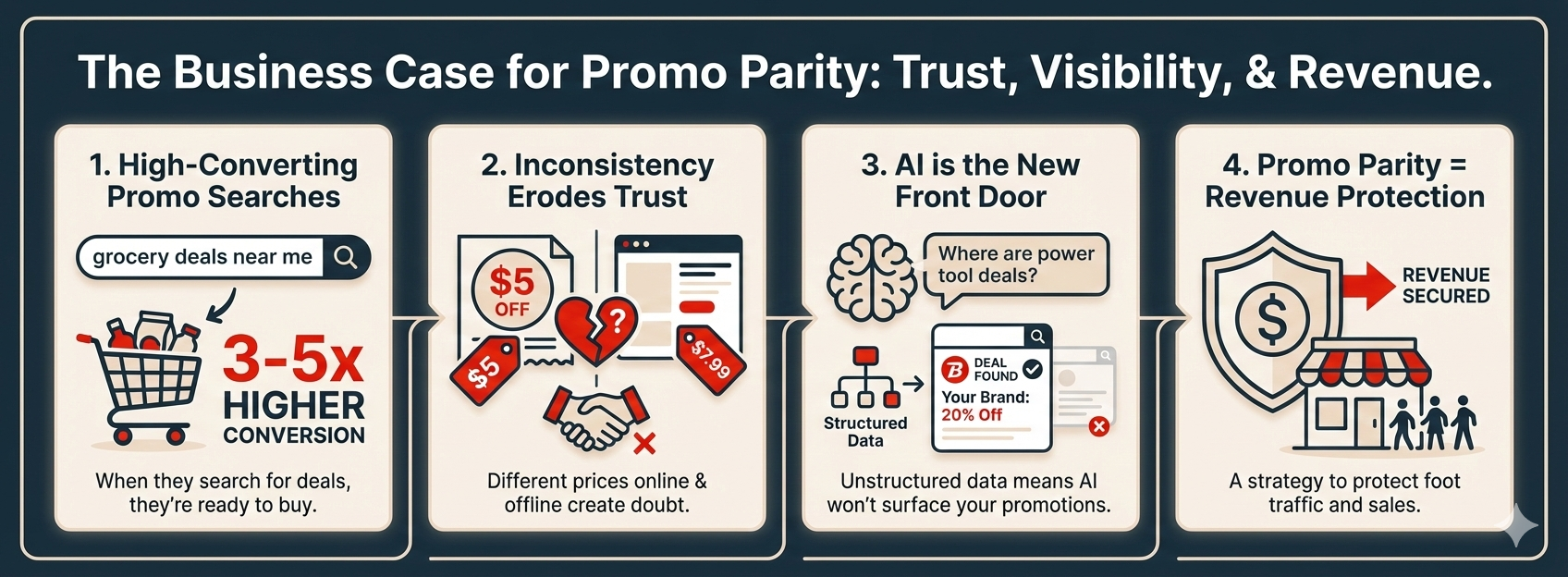
Promo-driven searches convert at 3-5x higher rates than general product searches. When someone searches for “grocery deals near me,” they’re ready to buy. If your promotions aren’t visible in those moments, you lose the sale.
Inconsistent promotions erode trust faster than bad customer service. When a shopper sees “$5 off” in your circular but “$7.99” on your website, they question whether they can trust your brand at all.
AI search engines are becoming the new front door. ChatGPT, Perplexity, and Google’s AI Overviews now answer questions like “Where can I find deals on power tools this weekend?” If your promo data isn’t structured and consistent, AI won’t surface your brand.
The bottom line? Promo parity is a revenue-protection strategy for retailers who depend on weekly promotions to drive foot traffic and sales.
Step 1: Audit Your Current Promo Visibility
Before you can fix promo parity, you need to understand where the breakdowns are happening.
Actionable Steps:
- Pull this week’s circular and list the top 5-10 hero promotions
- Search for those promotions on Google using queries like “[Your Brand] weekly ad” or “[Product] sale near me”
- Check your website category pages and PDPs for promoted items
- Review your Google Merchant Center feed to verify sale prices and dates
- Test AI search by asking ChatGPT or Perplexity about deals near your location
What you’re looking for: Gaps, mismatches, and promotions that exist in print but are invisible online. Most retailers find 3-5 major disconnects in the first 15 minutes.
Step 2: Establish a Single Source of Truth for Promo Data
One of the biggest reasons promo parity breaks down is that promotional data lives in too many places, and none of them talk to each other.
Your merchandising team builds the circular in InDesign. Your ecommerce team manually updates the website. Your feed pulls from a different system entirely. By the time a promotion goes live, it’s been re-entered 3-4 times with errors compounding at each step.
The fix: Create a single source of truth.
Actionable Steps:
- Centralize promo planning in a shared system where all promotional data is entered once
- Define required fields: Product SKU, promo type, sale price, start/end dates, promo description
- Assign ownership so one person or team maintains this source of truth before every promo cycle
Example: If your merchandising team finalizes the weekly ad every Wednesday for a Sunday launch, your promo data should be locked by Thursday morning, giving your digital team time to propagate it across all channels.
Step 3: Map Your Promo-to-Digital Workflow
Now that you have a single source of truth, you need a clear, repeatable workflow that ensures promo data flows to every digital touchpoint.
Actionable Steps:
- Map every touchpoint where promos need to appear (homepage, category pages, PDPs, Google feed, email, ads)
- Identify the handoffs and who is responsible for updating each touchpoint
- Build a promo launch checklist with tasks and deadlines
- Automate where possible to reduce manual errors
Built-in Flexibility Tip: Set aside 10-15% of your timeline for last-minute changes. Merchandising will adjust offers, and products will go out of stock.
Step 4: Optimize Your Google Merchant Center Feed for Promos
Most retailers’ Google Merchant Center feeds aren’t optimized for promotions. They might have sale prices populated, but they’re missing the structured promo data that Google needs.
Actionable Steps:
- Use the sale_price attribute correctly to reflect the promotional price
- Populate sale_price_effective_date with exact start and end times
- Add the promotion_id attribute to link your product feed to a promotions feed
- Submit a separate promotions feed describing offers in detail
- Test with Google’s Merchant Center Diagnostics tool
Example: Running “Buy One Get One 50% Off” on paint? Your main feed shows the discounted sale price. Your promotions feed describes the offer: “BOGO 50% Off Paint This Week Only.” Google now understands the promotion at a structured level.
Step 5: Ensure PDPs and Category Pages Reflect Active Promos
Your Google feed might be perfect, but if shoppers click through and see full price on your website, you’ve lost them.
Actionable Steps:
- Display sale prices prominently on PDPs with strikethrough regular pricing
- Add promo badges or callouts like “Sale” or “Weekly Ad Special”
- Show the promo end date to create urgency
- Propagate promos to category pages so sale prices appear in grid views
- Use structured data markup with Offer schema including price and expiration date
Actionable Tip: If your ecommerce platform supports dynamic promo rules, set them up once and let the system handle updates automatically.
Step 6: Make Your Promos Discoverable in Search and AEO
Even if your promotions are perfectly aligned across channels, they won’t drive traffic if customers can’t find them.
Actionable Steps:
- Create a dedicated weekly ad landing page updated every promo cycle
- Optimize for natural language queries like “deals on grills near me”
- Embed promotions in helpful blog content linking to promoted products
- Use FAQ schema answering questions like “What’s on sale this week?”
- Avoid trapping promos in PDFs. Always have an HTML version
Why this matters for AEO: AI search engines prioritize clearly structured content using natural language. By optimizing your promo pages for these characteristics, you increase the likelihood that AI will cite your promotions.
Step 7: Test, Measure, and Refine
Promo parity requires continuous testing and refinement.
Actionable Steps:
- Track promo-specific metrics like CTR on promoted products and conversion rates
- A/B test promo presentation to optimize engagement
- Create a feedback loop with store managers and customer service
- Monitor AI search results periodically
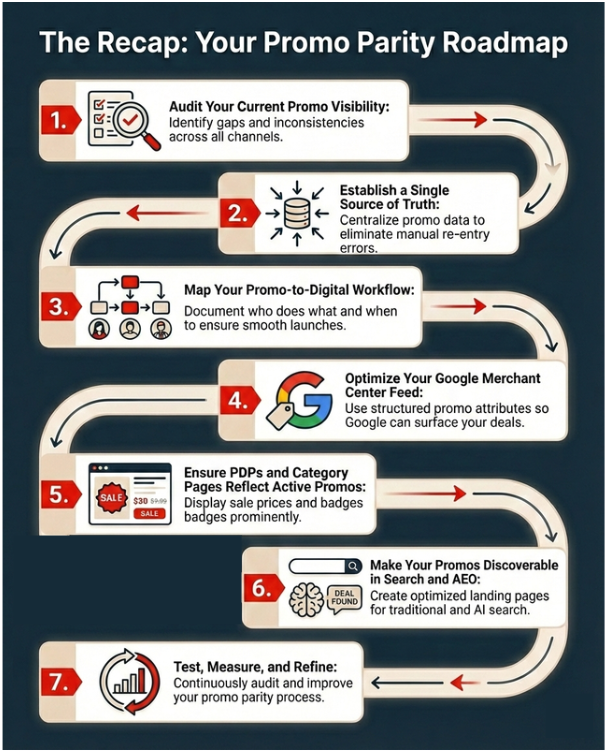
The Recap: Your Promo Parity Roadmap
- Audit Your Current Promo Visibility: Identify gaps and inconsistencies across all channels.
- Establish a Single Source of Truth: Centralize promo data to eliminate manual re-entry errors.
- Map Your Promo-to-Digital Workflow: Document who does what and when to ensure smooth launches.
- Optimize Your Google Merchant Center Feed: Use structured promo attributes so Google can surface your deals.
- Ensure PDPs and Category Pages Reflect Active Promos: Display sale prices and badges prominently.
- Make Your Promos Discoverable in Search and AEO: Create optimized landing pages for traditional and AI search.
- Test, Measure, and Refine: Continuously audit and improve your promo parity process.
Have Confidence in Your Promo Parity
At Augurian, we specialize in helping regional retailers digitize the weekly ad, achieve promo parity, and prove ROI to leadership. We’ve developed a four-stage promo parity maturity model for retailers & grocers that gives marketing, merchandising, ecommerce, and IT a shared roadmap for promo parity in the age of AI. It’s important because AI systems now summarize and present your deals to shoppers—often before they ever visit your website—so promo consistency alone isn’t enough.
FOUR-STAGE PROMO PARITY MATURITY MODEL:
Request a copy to pinpoint your stage and align the team on the highest-impact next steps here: Request the Download Here
And if you’d like to talk about building a scalable promo parity process for your team, let’s chat.

- A Complete Guide To Promo Parity - January 23, 2026
- The Mom Test and Sparking Behavior Change: ‘How I Work’ EP16 with Sean Higgins (BetterYou) - February 7, 2022
- ‘How I Work’ Ep 15 with Ryan Truax - November 4, 2021