In 2026, visibility is about being chosen by AI answer engines, not just about ranking on Page 1. Answer engines like Claude, Perplexity, Google AI Overviews, and ChatGPT operate on a fundamentally different model where influence occurs without clicks, authority builds without traffic, and brand impact happens without direct attribution.
According to McKinsey, roughly 50% of Google searches now return AI summaries, a figure expected to exceed 75% by 2028.
When Google’s AI Overviews synthesizes information from dozens of sources to answer an informational query, the most influential sources may never receive a single click, yet they shape decision-making processes and brand perceptions at scale. Recent research shows that traffic originating from large language model (LLM) answer engines converts at nearly nine times the rate of traditional organic search, underscoring that visibility without clicks can still produce outsized commercial impact.
In order to fully understand the scope of LLMs, how they operate and their differentiators, Augurian’s organic search team conducted a manual data collection study across four prominent answer engines: Google’s AI Overviews (AIO), Perplexity, Claude, and ChatGPT.
This comparative analysis examined one hundred generated outputs, evaluating each response across the following criteria:
- Response length (word count)
- Citation frequency (number of cited sources per response)
- First-page SERP overlap (percentage of citations appearing on Google Page 1)
- Recency signals (references to 2024–2025 data or temporal qualifiers)
- Brand reference presence (whether a client brand or domain was mentioned)
- Brand attribution type (cited, mentioned, or absent)
- Source transparency (visibility and clarity of citations)
- Tone (factual, conversational, opinionated, or neutral)
- Structural format (paragraph, list, or hybrid)
- Source type mix (governmental, educational, commercial, news, or blog content)
We also evaluated qualitative factors including factual inconsistencies, tonal bias, hallucinations, and other recurring linguistic patterns. Our analysis reveals AI answer engines prioritize structured authority over legacy ranking signals.
These patterns are not isolated to this study. Large-scale industry analyses examining millions of AI-generated responses have reached similar conclusions, showing that answer engines exhibit distinct citation behaviors, structural preferences, and source selection logic depending on the model and interface.
Key Finding #1:
Traditional SEO Signals Have Limited Influence on AI Citations
Only 29% of AI citations were from Page 1 of Google search results. This means more than 70% of citations come from sources ranking outside the traditional SERP’s top 10 listings. High ranking content does not guarantee AI visibility.
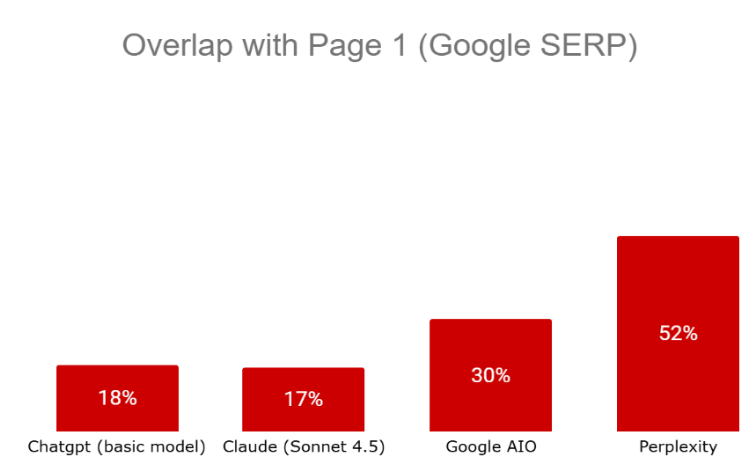
As SurferSEO notes, answer engine optimization (AEO) prioritizes being selected as the direct answer, not ranking highest in a list of results. AI systems are not browsing pages, instead they are extracting, synthesizing and presenting information.
Our study also showed that user generated platforms, government sites and technical documentation sources performed strongly while small local businesses and low visibility brands rarely appeared unless the query had location intent. Optimization is no longer about ranking mechanics. It’s about how content is interpreted, summarized, and reused by AI systems.
Tactical implication: Expand content formats beyond blog posts into structured lists, videos, and documentation.
Key Finding #2:
Recency Matters but Evergreen Authority Remains Competitive
Our study showed 57% of cited content was updated within six months. Perplexity shows a strong recency preference. However, evergreen authoritative domains such as government sites, Wikipedia and long-standing technical documentation remain highly visible even when older. AI systems balance freshness with authority, selecting pages that offer clear and consistent information irrespective of publication date.
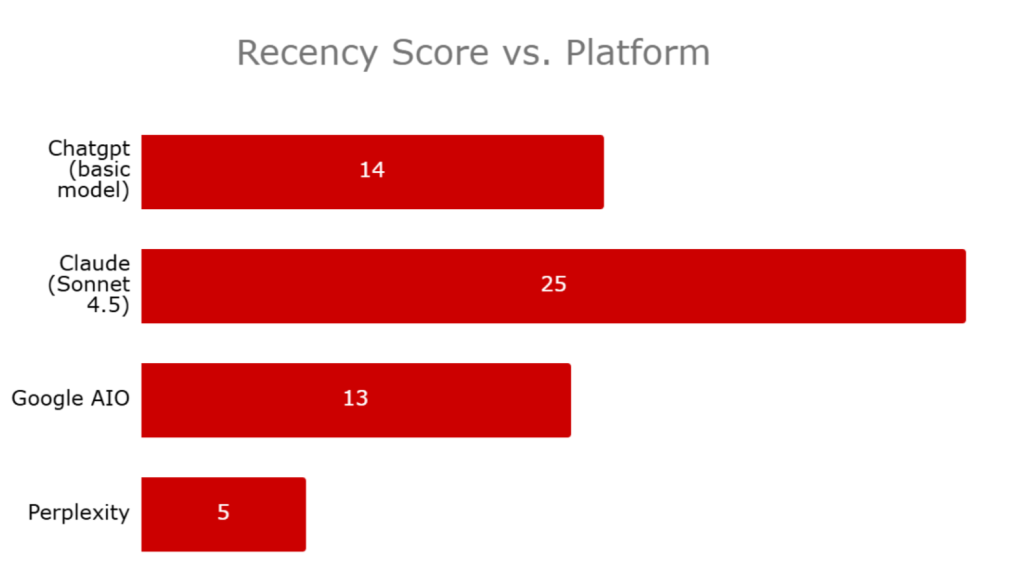
This aligns with Ahrefs’ analysis of ~17M cited URLs across 7 AI platforms, which found AI assistants cite content that is ~25.7% ‘fresher’ than traditional Google SERPs. Even so, Ahrefs also found the average cited URL is still ~2.9 years old, showing AI systems still lean on long-lived, authoritative sources.
If you want a step-by-step measurement system, see our guide on how to track brand impact in answer engines, including citation tracking, sentiment, prominence, and competitive share of voice.
Key Finding #3:
Platforms Exhibit Distinct Citation Patterns and Structural Preferences
ChatGPT and Claude produced longer answers with average word counts around 360 words. These two platforms often included more citations but offered inconsistent transparency in their outputs.
Google AI Overviews demonstrated the highest brand mention rate at 40% and also showed full transparency by consistently surfacing visible sources. Perplexity used the fewest citations but maintained high transparency and recency awareness.
The LLM raw dataset provides additional platform insights. Perplexity favored content with recent updates. Claude preferred highly structured pages with a strong hierarchy. ChatGPT accepted more varied content including shorter pages, thin pages and pages with minimal hierarchy. Google weighted business listings and knowledge graph signals more heavily than long form content.
Key Finding #4:
Brand Visibility Depends on Query Intent More Than Industry
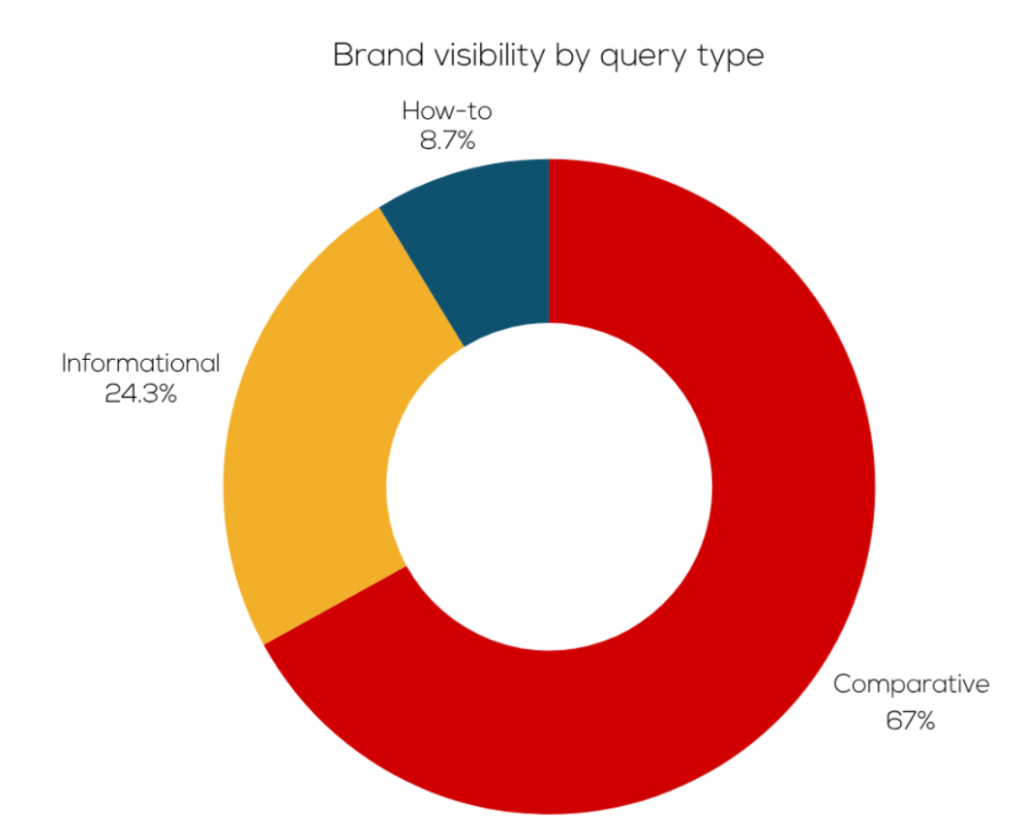
Brand visibility varied significantly across client industries. Local grocery retail performed best at 50% visibility, followed by industrial IoT at 39% and home heating at 22%.
The more revealing signal was query intent. Comparative queries achieved 69% visibility while informational queries reached only 25% and how to queries just 9%.
AI systems are far more likely to reference brands when users express comparison intent or decision intent rather than generic informational queries.
Key Finding #5:
Structured content was selected far more often than unstructured pages
Across engines, structured content like lists, bullets, and schema-enhanced pages was seen to be favored, with 94% of all responses incorporating lists, bullets, numbered sequences, or tables rather than pure paragraph formats.
This pattern was remarkably consistent across platforms: Google AIO and Perplexity structured 100% of their outputs, ChatGPT formatted 96% of answers with clear organizational elements, and even Claude (the most conversationally diverse platform) still structured 80% of responses. The preference intensified for specific query types: how-to queries received structured formatting 97.2% of the time, while informational queries hit 97.5%.
Beyond visual structure, the presence of schema markup proved equally critical.
The most frequently cited pages employed BreadcrumbList schema (47% of citations) and Person schema (45% of citations), indicating that structured data markup serves as a powerful signal for AI systems parsing and evaluating content authority.
Structured answers averaged 321 words compared to just 206 for unstructured responses, suggesting that answer engines not only favor structured source content but also invest more depth when they can organize information hierarchically.
The domains most frequently cited: YouTube (41%), Reddit (26%), and .gov sites (12% ), all feature inherently structured content with clear sections, step-by-step instructions, or threaded discussions.
This data reveals a fundamental shift in content strategy: pages that combine visual structural elements (lists, headers, tables) with technical structured data markup (schema.org) are significantly more likely to be selected and cited by AI systems, regardless of traditional SEO metrics like domain authority or page rank.
How Brands Can Influence AI Visibility
AI visibility is maturing into a measurable discipline, not intuition, requiring deliberate strategy rather than ad-hoc experimentation.
The findings indicate that visibility in AI driven search environments requires a diversified approach that goes beyond traditional SEO.
- Focus on comparative content: Comparative queries consistently drive the highest brand visibility.
- Diversify content formats: Platforms heavily reference YouTube, Reddit and technical documentation.
- Optimize beyond Page 1: Strong results often come from pages ranking beyond the top ten.
- Refresh content regularly: Recency influences multiple platforms and can significantly improve citation likelihood.
Conclusion
AI driven search is rewriting the rules of brand visibility. The evidence is clear. Query intent shapes outcomes. Platforms draw from a wider set of sources than Page 1 of Google. Video and community content outperform traditional articles. Recency influences multiple models. These patterns signal a decisive shift. Brands that continue to optimize only for rankings will struggle to appear in AI generated answers.
Visibility is now a function of relevance, structure and presence across the domains AI systems prefer to cite. This is not a passive shift. It is a strategic opportunity for brands that adapt early. Teams that invest in comparative content, diversify formats and refresh their pages regularly will place their brands where decisions are increasingly made.
Augurian’s services are built to help brands navigate this shift with clarity. We partner with teams to design the strategic frameworks required to earn visibility across AI-driven search experiences, where decisions are increasingly made before a click ever occurs.
Stop guessing how AI is shaping demand for your brand. Augurian will map your gaps, competitors, and the fastest wins. Explore our SEO services and content marketing services today!

- How to Track Brand Impact in Answer Engines - December 22, 2025
- Answer Engine Visibility: A Comparative Study of Google AI, Perplexity, ChatGPT & Claude - December 22, 2025